
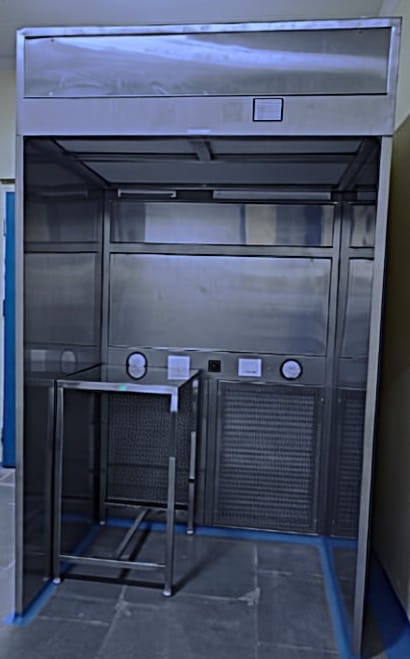
Objective for OQ of RLAF (Reverse Laminar Air Flow)
To determine that the OQ of RLAF (Reverse Laminar Air Flow) perform as intended by repeatedly running the system on its intended schedules and recording all relevant information and data. Results must demonstrate that installation consistently meets per-determined specifications under normal condition, and where appropriate the worst case situations.
To verify that the equipment operates in accordance with the design and user requirements as defined by set Acceptance Criteria and complies with relevant cGMP Requirements.
To verify the Operational features of Reverse Laminar Air Flow and to ensure that it produces desired Quality & rated output according to manufactures specifications.
To verify all the Operational features from user point of view of the Equipment, Cleaning Procedure, Start up & Shut down Procedure and Safety Features.
TABLE OF CONTENT
SCOPE
- The scope of this operational qualification protocol cum report is limited to qualification of Sampling Booth (Reverse Laminar Air Flow) installed in Packing Material Sampling Area.
- This Protocol will define the methods and documentation used to perform OQ activity the Sampling Booth (Reverse Laminar Air Flow) for OQ. Successful completion of this Protocol will verify that Reverse Laminar Air Flow meet all acceptance criteria and ready for Performance Qualification.
- This document is applicable for Sampling Booth (Reverse Laminar Air flow) located at company.
PRE APPROVAL OF DOCUMENTS
Prepared by
| Designation | Name | Date | Signature |
| Executive/Officer Engineering |
Reviewed By
| Designation | Name | Date | Signature |
| Head Engineering | |||
| Head Production | |||
| Head Warehouse | |||
| Head Quality Control |
Approved by
| Designation | Name | Date | Signature |
| Head QA |
SCOPE OF SUPPLY:
| Description | Specification |
| Make | |
| Model | |
| Serial no | |
| Control system | 220 volts, Single phase power supply |
BRIEF PROCESS DESCRIPTION for OQ of RLAF (Reverse Laminar Air Flow):
- Reverse Laminar Air Flow (RLAF) is a specialized air handling system used in the pharmaceutical industry to maintain a controlled and contaminant-free environment. By directing airflow from a contaminated area towards a clean area, RLAF prevents the introduction of contaminants into critical zones, ensuring the safety and quality of pharmaceutical products. Reverse Laminar Air Flow (RLAF), or Reverse Laminar Flow (RLAF), is a specialized air handling system used in pharmaceutical and clean room environments. It is designed to maintain a controlled environment by preventing the contamination of sensitive products, equipment, or processes.
- Unlike traditional laminar airflow systems, where the air flows from a clean area toward a contaminated area, RLAF operates in the opposite direction. The air flows from a contaminated area towards a clean area, minimizing the risk of contaminant introduction
- The working principle of Reverse Laminar Air Flow (RLAF) involves the controlled direction of airflow from a contaminated area towards a clean area, ensuring that contaminants are contained and prevented from reaching critical zones. Here’s a breakdown of the working principle:
- Airflow Direction: In RLAF, the airflow is reversed compared to traditional laminar flow systems. Instead of flowing from a clean area toward a contaminated area, the air is directed from a contaminated area toward a clean area.
- Contaminated Area: The contaminated area refers to the region where potentially harmful substances, particles, or processes are present. This can include areas with active pharmaceutical ingredient (API) handling, equipment cleaning, or other processes that generate contaminants.
- Clean Area: The clean area is the designated zone where sensitive pharmaceutical products, equipment, or processes requiring a controlled environment are located. It could be an aseptic filling line, sterile compounding area, or any other critical zone.
- Airflow Pattern: RLAF creates a controlled airflow pattern that effectively prevents contaminants from entering the clean area. The airflow is typically generated by ventilation systems, air handlers, and HEPA (High-Efficiency Particulate Air) filters.
- Containment and Exhaust: The RLAF system ensures that the contaminated air is contained within the contaminated area and exhausts safely. This prevents the spread of contaminants to the clean area and maintains the required cleanliness levels.
- Air Filtration: RLAF systems incorporate HEPA filters that effectively capture and remove airborne particles and microorganisms. These filters have high efficiency in removing particulate matter, typically with an efficiency of 99.97% for particles as small as 0.3 micrometers.
- Validation and Monitoring: Regular validation and monitoring of the RLAF system are crucial to ensuring its effectiveness. Airflow velocity measurements, particle counts, and microbial sampling are performed to verify that the system is operating within specified parameters and meeting regulatory standards.
REQUIRED UTILITES:
| Utility/ Parameter | Features |
| Electrical Utility | Voltage: 220 V AC ± 5% |
| Frequency: 50 Hz ± 2% | |
| Connection: 3 Wire | |
| Phase: 1 Phase, 1 Neutral,1Earthing |
OPERATION QUALIFICATION PROCEDURE:
- The Operational Qualification status of the Sampling Booth (Reverse Laminar Air flow) shall be checked and the execution shall be started only after completion of Installation Qualification report.
- Availability of calibration certificates of all the attached instruments shall be checked.
- The power supply and connected utility shall be checked before starting Operational Qualification.
- The operating functions of control panel switches and buttons shall be checked.
- The motor functioning test shall be performed.
- The functioning of sealing check as per bottle sealing diameter
- No Deviation observed during Operation Qualification.
OPERATIONAL VERIFICATION
Objective of this operation verification is to provide documented evidence that system/ equipment/ instrument operate as per respective standard operating procedure and up to its operating range.
Standard Operating Parameters Verification
Objective:
Objective of this verification is to provide documented evidence that system/ equipment/ instrument operate satisfactory as per its standard operating procedure.
Test Method:
Acceptance Criteria:
System/ Equipment/ Instruments shall be operate as defined in the standard operating procedure, if differ then record deviation.
Operation shall be smooth and there should not be any abnormal sound/ noise.
Results:
Record the results in below table.
| Test | Acceptance Criteria | Observations (Ok Not ok) | Observed by Sign/Date |
| Blower On / Off Switch Press Switch On Position. Press Switch Off Position | Blower Should Start. Blower Should Stop. | ||
| Light On / Off Switch Press Switch On Position. Press Switch Off Position. | Light should get ON. Light should get OFF. | ||
| Function of Magnehelic Gauge Starting of Magnehelic Gauge. | Needle of Magnehelic Gauge should Start from Zero. | ||
| Inspect for any abnormal noise/sound. | There should not be any abnormal noise/ sound. | ||
| Main Power shut down | Equipment stops in safe and secure condition | ||
| Main Power Restored | Equipment can be restarted with no problems or adverse condition |
SAFETY FEATURE & ALARM
| Safety feature | Function | Identified by/Date |
| Electrical Insulation | Safety | |
| Earthing | To avoid the shock |
POST APPROVAL OF DOCUMENTS
Prepared by
| Designation | Name | Date | Signature |
| Executive/Officer Engineering |
Reviewed By
| Designation | Name | Date | Signature |
| Head Engineering | |||
| Head Production | |||
| Head Warehouse | |||
| Head Quality Control |
Approved by
| Designation | Name | Date | Signature |
| Head QA |
LIST OF ABBREVIATIONS
| ENG | Engineering |
| OQ | Operational Qualification |
| cGMP | Current Good manufacturing Practices |
| GMP | Good manufacturing Practices |
| HEPA | High-Efficiency Particulate Air |
| AC | Alternate Current |
| V | Volt |